On Friday, June 12, 2026, Anthropic said it had to abruptly disable Claude Fable 5 and Claude Mythos 5 for every customer.
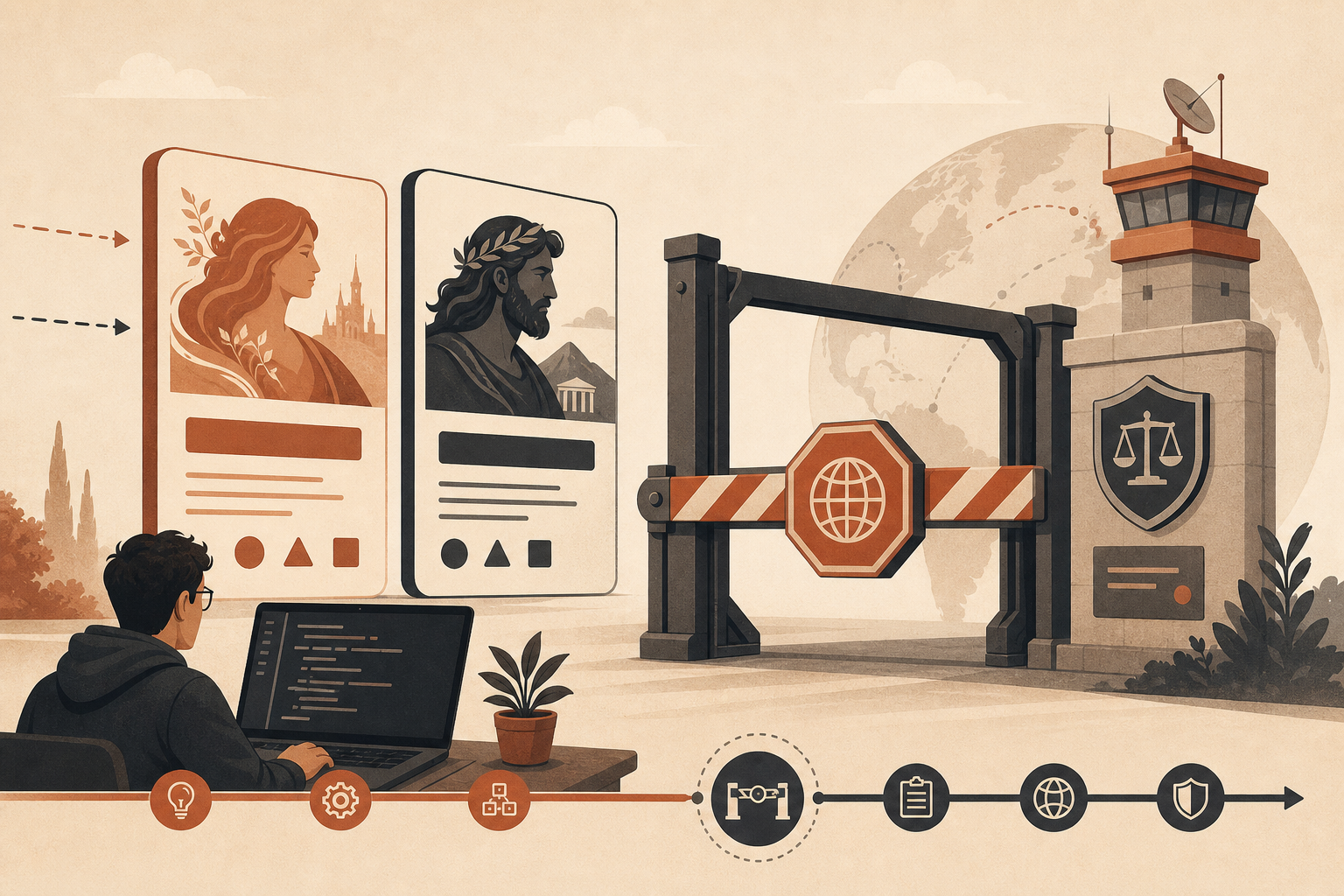
The trigger was a US government export-control directive. Anthropic says the order suspends access to Fable 5 and Mythos 5 by any foreign national, “whether inside or outside the United States,” including foreign-national Anthropic employees. Because that is hard to enforce perfectly at product speed, Anthropic’s immediate operational answer was blunt: turn both models off for everyone while it complies (Anthropic).
The important caveat: all other Claude models are unaffected. If your app uses Sonnet, Opus, Haiku, or older Claude models, this specific directive does not apply to those models, according to Anthropic’s statement.
What happened
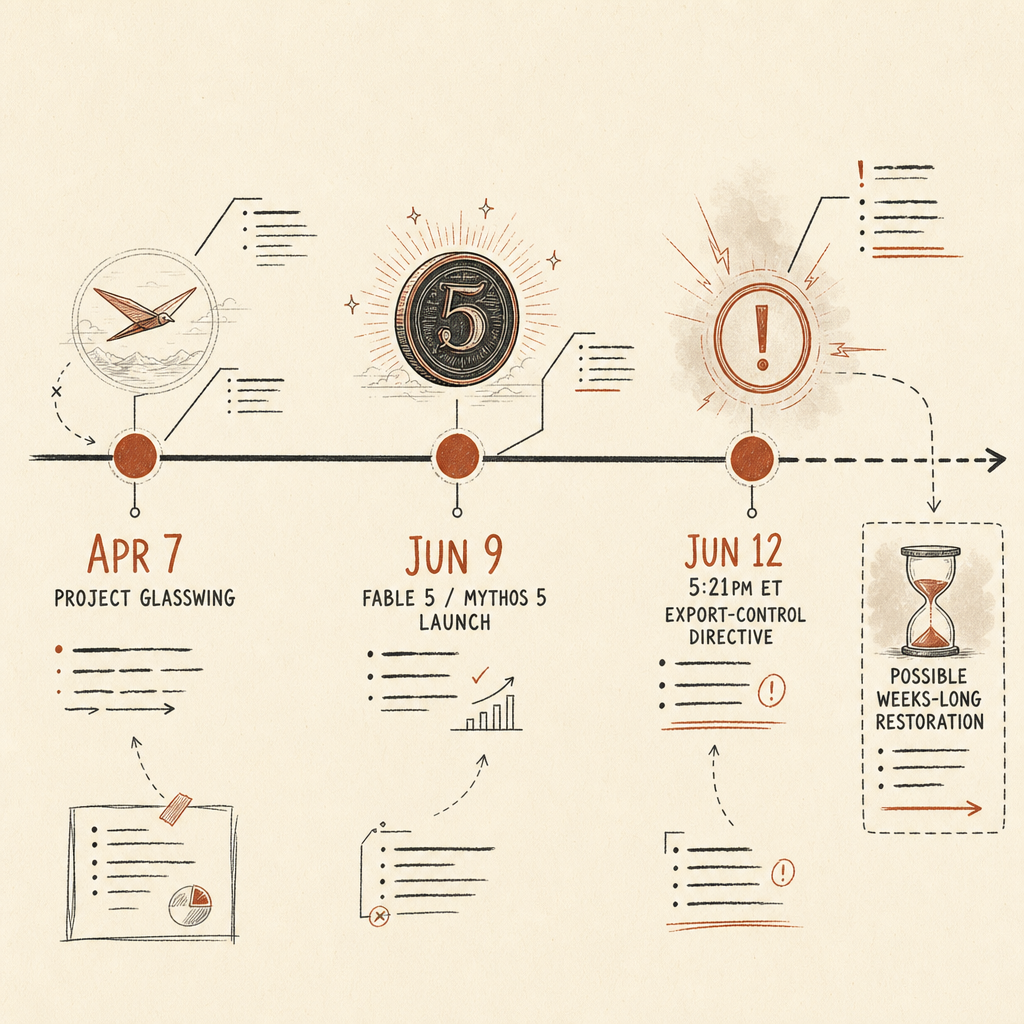
Anthropic received the directive at 5:21pm ET on June 12, according to the company’s statement. The company said the letter cited national security authorities but did not give specific details of the concern (Anthropic).
Axios reported the same day that Commerce Secretary Howard Lutnick sent a letter to Anthropic CEO Dario Amodei saying Mythos 5 and Fable 5 would be subject to export controls outside the US and to all foreign persons inside the US (Axios). Reuters then covered the Axios report, noting it could not immediately verify it and that Commerce, the White House, and Anthropic had not immediately responded to Reuters’ requests for comment at that time (Reuters via MarketScreener).
The scope matters. This is not a country block. It is not only an overseas block. It is a foreign-person rule: a non-US national sitting in San Francisco is covered, at least as described by Anthropic and Axios. That makes enforcement messy for a cloud API used by teams, contractors, CI jobs, model routers, and end users with different legal statuses.
Axios also reported that the Commerce letter creates a licensing regime: export, re-export, or domestic transfer would require a license, with an additional application for individually validated licenses. Axios said failure to comply would carry financial and civil penalties (Axios).
That is why Anthropic did not just geofence a few countries. It removed access to both models.
The timeline
Fable 5 and Mythos 5 were only public for a few days.
Anthropic launched them on June 9, 2026. Fable 5 was the generally available Mythos-class model. Mythos 5 used the same underlying model but with safeguards lifted in some areas for vetted cyberdefense and infrastructure partners (Anthropic launch post).
At launch, Anthropic described Mythos-class models as a tier above Opus. It positioned Fable 5 as the safer public release: the model would block or route high-risk cyber, biology, and chemistry requests away from Fable’s full capabilities. The fallback model for some risky areas was Claude Opus 4.8 (Anthropic Mythos page).
The price was clear: both Fable 5 and Mythos 5 were offered at $10 per million input tokens and $50 per million output tokens, less than half the price of the earlier Mythos Preview, according to Anthropic (Anthropic launch post).
| Model | Intended access before June 12 | Price | Status after directive |
|---|---|---|---|
| Claude Fable 5 | General Claude API access | $10/M input, $50/M output | Disabled for all customers |
| Claude Mythos 5 | Vetted trusted-access partners | $10/M input, $50/M output | Disabled for all customers |
| Other Claude models | Normal availability | Model-specific | Unaffected by this directive |
On June 12, Axios reported that the administration acted after another company claimed it had jailbroken Mythos. Axios also reported an administration official saying the models need to stay locked down until the US national security apparatus is hardened, which the official said could happen “in the next few weeks” (Axios).
That last phrase is the closest thing developers have to a restoration window. It is not a commitment from Anthropic. Treat it as a political and compliance signal, not an SLA.
The jailbreak dispute
The government’s apparent trigger was a jailbreak claim. The details are thin.
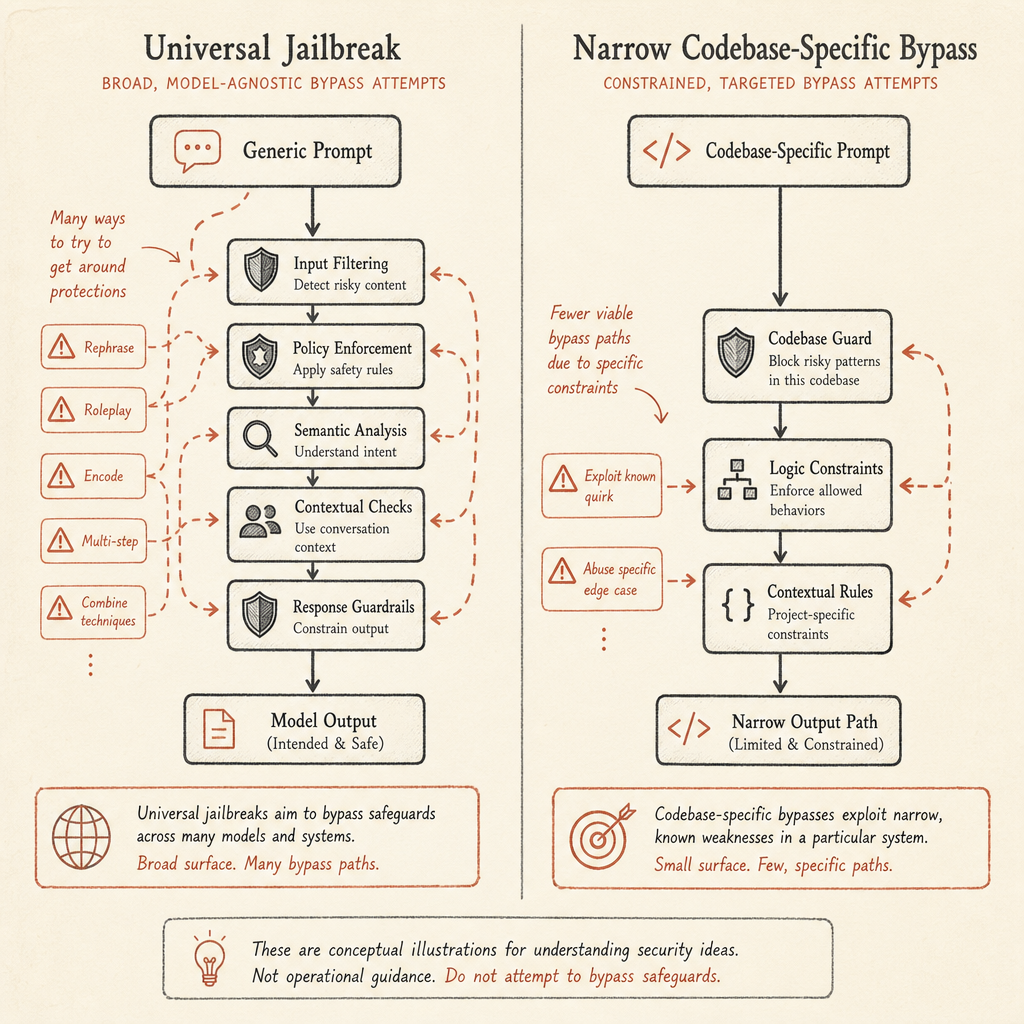
Anthropic says its understanding is that the government became aware of a method for bypassing, or jailbreaking, Fable 5. Anthropic says it reviewed a demonstration where the technique identified a small number of previously known, minor vulnerabilities. The company’s pushback is direct: those vulnerabilities “appear relatively simple,” and other public models could discover them without a bypass (Anthropic).
Anthropic also says the government has only provided verbal evidence of a narrow, non-universal jailbreak. The company describes the alleged technique as essentially asking the model to read a codebase and fix software flaws. Anthropic says it has not received a disclosure of a concerning non-universal jailbreak that led to a harmful result, and says no tester has found a universal jailbreak for Fable 5 (Anthropic).
The company’s broader argument is that the demonstrated capability is not unique to Fable or Mythos. Anthropic says it reviewed what it believes is the report behind the directive and found that the same level of capability is widely available from other models, including OpenAI’s GPT-5.5 (Anthropic).
That is the policy fight in one sentence: the government appears to be treating one Anthropic model family as an export-controlled national-security asset; Anthropic says the cited behavior is narrow, already common across frontier models, and not a technical basis for recalling a commercial model.
Why developers should care
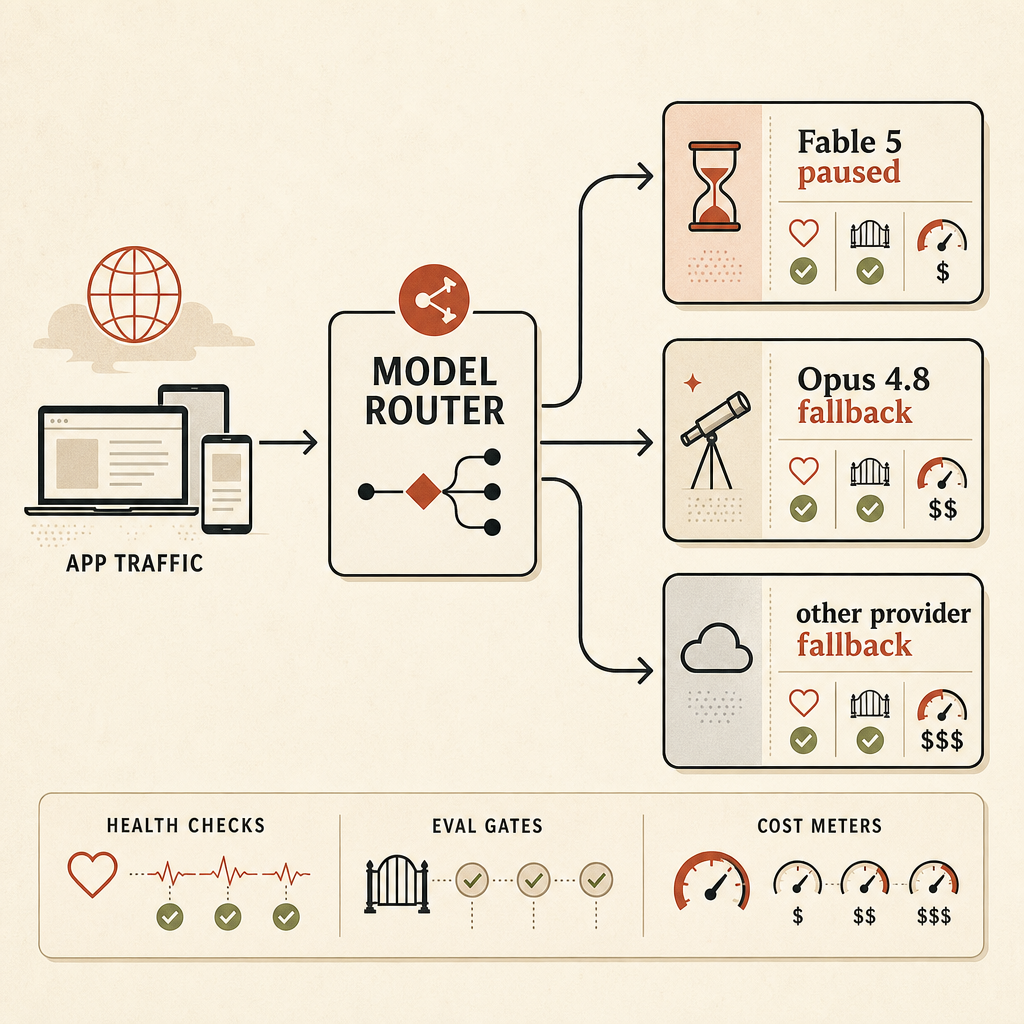
If you built on claude-fable-5, your integration is broken until access returns or you route around it. The failure mode depends on where you call it: direct Claude API, an enterprise contract, a third-party gateway, or an internal model router. But the product-level fact is the same. The model is unavailable.
A sane immediate fallback looks boring:
const model = process.env.CLAUDE_MODEL ?? "claude-opus-4.8";
// previously: "claude-fable-5"
Do not hard-code the replacement everywhere. Put it behind a routing layer, config flag, or provider abstraction. This is now a live example of model availability risk, not just model quality risk.
For teams using Fable 5 for agentic coding, repo-wide migrations, large-context review, or multimodal debugging, the fallback is not purely syntactic. Anthropic marketed Fable 5 around longer autonomous work, stronger software engineering, improved vision, memory, and long-context behavior. Anthropic’s launch post says Fable 5 can work autonomously longer than previous Claude models, and cites customer examples like a codebase-wide migration in a 50-million-line Ruby codebase (Anthropic launch post).
So you should expect behavioral drift if you swap to Opus 4.8, Sonnet, GPT-5.5, Gemini, or a smaller routing model. Re-run evals. Especially for code agents that write patches, execute tests, or touch production repos.
Practical checklist:
- Replace direct
claude-fable-5calls with a configurable model alias. - Add a provider-health check before long-running agent jobs.
- Re-run your internal evals on the fallback model.
- Watch token costs. Fable 5 was $10/$50 per million tokens; your fallback may be cheaper, more expensive, or less efficient per completed task.
- Tell customers if output quality, latency, or supported workflows changed.
- Keep Claude non-Fable models enabled if they meet your policy and quality bar, because Anthropic says they are not affected by this directive.
The bigger signal
This incident changes the deployment model for frontier AI. A model can be launched, priced, documented, integrated, and then removed days later because an agency letter changes its legal status.
The strange part is that Anthropic has been asking for more serious AI regulation. In the same statement, the company says it believes the government should be able to block unsafe deployments through a transparent statutory process grounded in technical facts. Anthropic’s complaint is that this action, in its view, does not meet that standard (Anthropic).
That distinction matters for developers. Clear rules can be engineered around. Sudden model-specific directives are harder. They create operational uncertainty: not just “which model is best?” but “which model can I legally serve to this user, through this employee, from this environment, tomorrow?”
For now, the narrow answer is simple. Fable 5 and Mythos 5 are off. All other Claude models remain available. The restriction may be temporary, with Axios reporting that an official framed the lock-down period in weeks, not months (Axios). But developers should not build on “maybe back soon.”
Build the escape hatch. Keep evals portable. Treat model IDs like dependencies with legal and supply-chain risk, not constants.
If access returns next week, you can switch the router back. If it does not, your app should already be running.
If you want to try Claude Fable 5.1 yourself, you can reach it through Claude Fable 5.1 through RouteMux — a drop-in endpoint at 72% below Anthropic’s official pricing. Add a balance and get a key; whatever you don’t spend is refundable.
Further reading: Getting started with Claude Fable 5.